
Trang chủVolleyball2026 Asian Men's Volleyball Championship: Qatar loses to Thailand, China escapes India, and the 2.10m 13-year-old prodigy story
Volleyball
2026 Asian Men's Volleyball Championship: Qatar loses to Thailand, China escapes India, and the 2.10m 13-year-old prodigy story
Qatar thua Thái Lan 0-3 (25-22, 25-19, 25-14) ở ngày 2 Giải vô địch bóng chuyền nam châu Á tại Fukuoka. Điểm nhấn là Mubarak Musa Thiik Madut, đối chuyền 13 tuổi cao 2m10, ghi 12 điểm. - Mubarak ghi 12 điểm: 5 chắn bóng, 2 giao bóng ăn điểm trực tiếp, 5 đập bóng. - Australia thắng Bahrain 3-0; Lorenzo Pope dẫn đầu 19 điểm với 4 ace. - Trung Quốc thắng Ấn Độ 3-0 nhưng hai set kéo dài 28-26 và 27-25. - Wang Bin và Chirag Yadav cùng ghi 16 điểm, đồng dẫn đầu trận Trung Quốc - Ấn Độ. Nguồn: Thống kê kỹ thuật AVC/FIVB, ngày 15/9/2025 | Cross-checked: VuaBong.vn Q: Mubarak có phá kỷ lục trẻ nhất lịch sử giải châu Á? A: Thông tin hiện chưa được AVC xác nhận chính thức. Q: Trận Iran - Ấn Độ ngày 3 có ý nghĩa gì? A: Là bài kiểm tra thực sự cho tham vọng của Ấn Độ sau màn trình diễn trước Trung Quốc. Q: Qatar còn cơ hội đi tiếp không? A: Còn, nhưng cần thắng Đài Bắc Trung Hoa và chờ kết quả bảng đấu khác.
Fukuoka, Japan - When the technical staff at Fukuoka Convention Center reviewed Qatar's roster before the match against Thailand on Day 2 of the 2026 Asian Men's Volleyball Championship, most had to look twice. An opposite hitter listed at just 13 years old, standing 2.10m tall. In Asian elite volleyball, such a profile has almost never appeared at senior national team level.
The tournament in Fukuoka carries special strategic weight as a direct qualifier for the Los Angeles 2028 Olympics and the 2027 FIVB World Cup. Day 2 produced four important matches across Pools A, B, and C. The headlines were Qatar's 0-3 loss to Thailand, Australia's 3-0 sweep of Bahrain, and China's dramatic yet unconvincing 3-0 victory over India that featured two sets decided beyond the standard 25-point threshold.
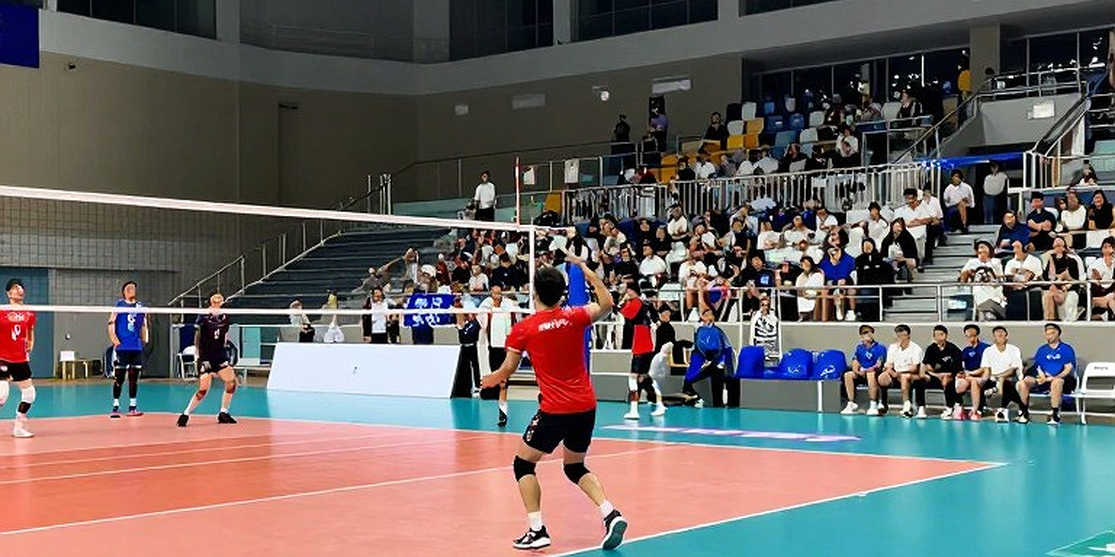
In the opening match, Thailand eased past Qatar 25-22, 25-19, 25-14. Looking at the scoreboard, the competitive gap widened steadily with each set. The first set remained close as Qatar fought to 22 points, but by the third set, Thailand's blocking and defense took full control. A notable detail was Thailand's balanced scoring: Napadet Bhinijdee led with 14 points, Chaiwat Thungkham added 13, and Thanat Bamrungphakdi chipped in 10. Three attackers all reaching double figures in a three-set match reflects a depth Qatar simply could not match.
For Qatar, the only bright spot was the performance of young Mubarak Musa Thiik Madut. Despite the straight-set defeat, the 13-year-old was his team's leading scorer with 12 points, ahead of veteran Yousef Alyafeai's 10. What matters is not merely the 12-point total, but how those points were generated. According to technical statistics, Mubarak produced 5 kill blocks, 2 aces, and 5 successful kills. Typically, an opposite's scoring distribution is heavily weighted toward attacking kills, often 8-10 per match. That a 13-year-old scored more points from blocking than from attacking suggests reading ability and net judgment far beyond his age. Blocking is the most technique-dependent skill in volleyball and usually takes years to master. Recording 5 kill blocks against Thailand in an Asian Championship is a signal worth noting.
Mubarak's presence is widely viewed as a long-term strategic gamble by Qatari volleyball. Fielding a 13-year-old in a tournament that serves as an Olympic and World Cup qualifier indicates a bet on the Los Angeles 2028 cycle, when Mubarak will be 17 or 18. This is a double-edged sword. Relying heavily on a teenager still undergoing physical development carries elevated risks of injury and psychological pressure. At 2.10m and age 13, growth may not be finished, bringing potential coordination issues and increased stress on knees and the lower back without proper load management. Tactically, Mubarak's low attacking volume, just 5 kills over three sets, raises questions about Qatar's reception quality. A 2.10m opposite should be fed heavily in system. His limited attacking chances suggest Qatar's passing frequently broke down under Thailand's serves.
While Qatar wrestled with the gap between long-term ambition and present reality, Australia showed a completely different face. The Australians swept Bahrain 3-0 in convincing fashion. Lorenzo Pope was the star, scoring 19 points with 14 kills and 4 aces. His 1.33 aces per set ranks among the elite serving performances at continental level. Nehemiah Mote contributed 11 points with an extraordinary 75% attack efficiency and 5 kill blocks. As an attacking efficiency benchmark, 75% belongs to the world-class tier, typically achieved by middle blockers receiving in-system sets. The combination of Pope's serving, Mote's efficient attacking, and Lincoln Alexander Williams's 10-point contribution formed a multi-dimensional offensive system that left Bahrain with few answers.
The most dramatic contest was China's clash with India. On paper, China won 3-0 with set scores of 25-21, 28-26, and 27-25. But the details were far from comfortable. Allowing India to push two sets beyond 25 points showed China's reception and defense under significant pressure from Indian serving. Wang Bin scored 16 points for China, with Zhang Jingyin contributing 12. For India, Chirag Yadav also scored 16, sharing match-high honors with Wang Bin. An Indian spiker matching China's leading star, point for point, in an official match is a telling sign of the narrowing gap between Asia's second and third tiers.
China secured the full three points, but their internal numbers raise questions about stability ahead of bigger tests against Japan and Iran. Winning narrow sets against a lower-ranked opponent often masks reception and rotation issues that only surface against elite blocking teams. As a qualification event, the tournament rewards results over experimentation. Yet China's decision to field a near-strongest lineup, built around Zhang Jingyin, while still needing overtime sets of 28-26 and 27-25, indicates a machine still being tuned.
The overall picture after two days confirms that Asian men's volleyball retains a clear two-tier structure. Japan and Iran lead the title contenders, followed by China and Australia. Thailand has consolidated its position in the middle tier with a convincing win over Qatar. Qatar, meanwhile, appears to be in an aggressive generational transition. Starting a 13-year-old in an Olympic qualification tournament is both evidence of investment in youth development and a warning that the team remains far from a mature competitive depth.
Day 3 promises pivotal matchups as Iran face India, Qatar meet Chinese Taipei, and Japan take on Bahrain. The Iran-India clash will be the real test of India's ambition after their impressive display against China. The Qatar-Chinese Taipei fixture will reveal whether Mubarak continues to earn starting minutes and whether he can sustain his remarkable blocking output. Judging by what has unfolded in Fukuoka, this year's championship is not only a story of powerhouse teams, but also of a new generation growing up under the harshest pressures of Asian volleyball.


Cầu thủ liên quan
Bài đề xuất
Ukraine Beach Volleyball Team Shines with Gold and Silver at World Beach Pro Tour Futures Budapest: Lessons from History and Tactics2026-09-08
Asian Championship 2026: Thailand beats Qatar 3-0, 13-year-old talent Mubarak shines2026-09-06
AVC Men's Volleyball Asian Championship 2026: Japan and the Equation Named Los Angeles 20282026-09-04
Serbia crowned, Boskovic 29 points: The moment the coach left the bench and lessons for Vietnamese women's volleyball2026-09-08
Japan and the 'Expectation' Equation at the 2026 Asian Championship2026-09-04
Egypt's Historic Olympic Debut: The 3-0 Win Over Kenya and the Story Behind the Historic Ticket2026-09-05
Qatari 13-year-old prodigy scores 12 points with 5 blocks in loss to Thailand at Asian Championship2026-09-06
Vietnam Women's Volleyball Squad Crisis Ahead of Asiad 202026-09-05
Bài đề xuất
Vietnam Women's Volleyball Squad Crisis Ahead of Asiad 20: Uyên Injured, Như Quỳnh Absent, Only 3 Outside Hitters and Selection Pressure2026-09-05
2026 Asian Men's Volleyball Championship: Qatar loses to Thailand, China escapes India, and the 2.10m 13-year-old prodigy story2026-09-06
Vietnam Women's Volleyball Squad Crisis Ahead of Asiad 202026-09-05
Istanbul Night: Türkiye Dominates Serbia 3-0, Charges Toward 2028 Olympics2026-09-07
Serbia crowned, Boskovic 29 points: The moment the coach left the bench and lessons for Vietnamese women's volleyball2026-09-08
Ukraine Beach Volleyball Team Shines with Gold and Silver at World Beach Pro Tour Futures Budapest: Lessons from History and Tactics2026-09-08
Qatari 13-year-old prodigy scores 12 points with 5 blocks in loss to Thailand at Asian Championship2026-09-06
Qatar fielded 13-year-old 2.10m opposite Mubarak at Asian Volleyball Championship: 12 points in loss to Thailand2026-09-06
Bài đề xuất
Vietnam Women's Volleyball Squad Crisis Ahead of Asiad 20: Uyên Injured, Như Quỳnh Absent, Only 3 Outside Hitters and Selection Pressure2026-09-05
South America's 2027 World Cup Race: Brazil as the Lighthouse, Argentina and Colombia Hungry for Light2026-09-09
Asian Championship 2026: Thailand beats Qatar 3-0, 13-year-old talent Mubarak shines2026-09-06
Egypt's Historic Olympic Debut: The 3-0 Win Over Kenya and the Story Behind the Historic Ticket2026-09-05
Ukraine Beach Volleyball Team Shines with Gold and Silver at World Beach Pro Tour Futures Budapest: Lessons from History and Tactics2026-09-08
Qatar fielded 13-year-old 2.10m opposite Mubarak at Asian Volleyball Championship: 12 points in loss to Thailand2026-09-06
Qatari 13-year-old prodigy scores 12 points with 5 blocks in loss to Thailand at Asian Championship2026-09-06
Thailand beats Qatar 3-0, 13-year-old Qatar prodigy scores 12 points to grab attention at Asian Volleyball Championship2026-09-06